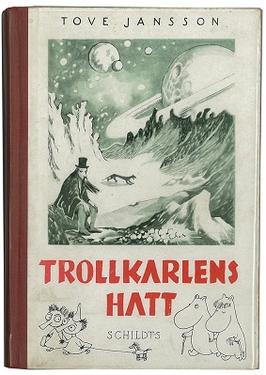
I love Tove's pen and ink drawings — and I learned to read because I was so intrigued by what the pictures suggested. And her outlook is so pleasing (in fact I have worn out three copies of this, mainy because English bookbinding was so poor).
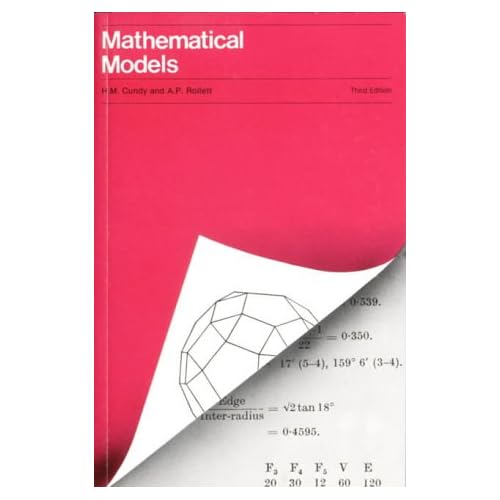
The probably surprising other choice is Cundy and Rollet's Mathematical Models comes from a masterstroke by my Dad, he noticed that my maths were falling behind the school's trammelled and classist expectations of us the 'bottom group of the year'. The first I made was a dodecahedron and I was just amazed:

(no silly joke should be made of by the fact that this shape is classed as a "Platonic Solid"!). I subsequently discovered the huge world of Archimedean Duals, although my maths didn't improve, but I was suddenly empowered to make these purely wierd objects, and just the hypnotic pleasure of these crystaline objects — objects of perfection that I, I had made this!! The teachers behaved with utter disinterest and disdain that I was producing these more and more complicated models: from the 12 facets of a dodecahedron to the 72 facets or more of the more outlandish Polyhedra was not to be encouraged: Something I thought would have been the strangest and notable thing to them about me.
No curiosity, no "But why would this scrawny little oik be talking Greek to me?"
If I'd been their teacher I would have been fascinated to engage in his progress.

4 comments:
http://www.swarovski.com/index/
I often go to the above site just to look at the facets. I actually own three pieces, all too big to wear (I cannot afford to attract the attention), but ask why I have it? To stare at the cut. It is really weird, I think about the earth and in a strange way I think it likes me! LOL!
I read a very long article in The New Yorker a few months ago. A physicist, or maybe he was a rocket scientist, quit his job to fold origami. He is now one of the most famous origami folders. Some folds are so intricate he has to get lasers to make the line for the place of the fold. I think I still have the article, I will look it up tomorrow and find his name.
Yes, the culture of origami is fascinating, I heard an interview with a scientist saying how paper folding had been a revelation to his research – I can't remember how, but I was so impressed!
I like the link you sent me – its amazing what people make.
_________________________________
One of Moomintroll's friends is excited by diamonds, Sniff is a good example of how greed looks in the "Jante Law" of Scandinavia.
The thing I love about the Moomins, is the feeling of how life might be like in a commune. There is 'care', 'patience', and enchantment.
We get a good picture of outsiders: scary and unpopular characters just move through events and do what they do, they aren't challenged or fought like in American stories! The Groke or Hattifatteners have an equally legitimate role in Moomin-world.
The books in the series, in order, are:
Prequel. The Moomins and the Great Flood (Originally Småtrollen och den stora översvämningen) - 1945
Comet in Moominland some editions The Happy Moomins - (Originally Kometjakten / Kometen kommer) - 1946
Finn Family Moomintroll (originally Trollkarlens hatt) - 1948
The Exploits of Moominpappa some editions Moominpappa's Memoirs (originally Muminpappans bravader / Muminpappans memoarer) - 1950
Moominsummer Madness (originally Farlig midsommar) - 1954
Moominland Midwinter (originally Trollvinter) - 1957
Tales from Moominvalley (originally Det osynliga barnet) - 1962 (short stories)
Moominpappa at Sea (originally Pappan och havet) - 1965
Moominvalley in November (originally Sent i november) - 1970 (in which the Moomin family is absent)
I'm going to see if I can get a copy from barnes & Noble
The art work in "Comet in Moominland" and "Memoirs of Moominpappa" is splendid.
And the later ones like "Moominvalley in November" really depressed me because of a sharpening of her pen style, and that goes in line with the idea of what Novembers are like. I couldn't read it beacause these wet and buffeted little Moomins looks so sad.
Interesting that it goes in line with Tove's age and optimism.
Post a Comment